

Recaps and Reflections
Ain’t nothin but a G Thing: on generosity, gratitude and The Guided Retreat
Updated and corrected version.


This is probably the last edition of Recaps and Reflections for the year.
In 2025, A Love Letter planted a seed of practical insights on ubuntu and isintu for love, life, leadership and legacy. In 2026 we are nurturing the seedlings.
I write for slow reading, contemplation and conversation.
I encourage you to re-visit older posts in A Love Letter once in a while to see what else will capture you. I also encourage you to discuss A Love Letter with your people.
In this Edition:
A person with purpose: What 2025 had in store for me
Shift or shatter: How my work is evolving as I recover from burn-out
Some say polymath: How I balance being isangoma and a coach
Gratitude and generosity: What The Guided Retreat reminded me about my core values
The Guided Retreat (I’ve struggled to produce a worthy and fitting recap, will try in 2026. You kinda just had to be there xo)
Watch: A Love Letter and interview on wellness in the workplace
Give and Gain: What isintu teaches us about generosity and gratitude
Watch: A Love letter on isintu and indigenous intelligence
A Guided gift for you : Grit, Grace and Growth
A person with purpose
2025 brought clarity that feels both overdue and right on time. I love being grown, I don’t love growing pains.
I turned 40, published a new book and then…as a treat for being high functioning: I have severe burn out.
Well, it’s been 9 months of recovery, and in that time, we launched our Guided Retreat…
As you can imagine, I just didn’t feel like doing another new thing, and in a recession, no less. But, I couldn’t keep working in the way I had been working: too much demand for my sangoma & coaching practices, too many client requests, too long a waiting list. ayi.
Shift or shatter
This last (certainly not the first) bout of burnout was my final warning: Shift, or shatter.
I hadn’t quite said this as blatantly and directly before 2025, and yet, I didn’t stutter: I am generous with my experience, and out of gratitude for my expertise : I only work with people who are competent, functional and self-driven.
I cannot allow myself to compromise on this standard like I did before, out of a sense of loyalty. That led me to build resentment for my practice and station.
Neither my calling nor coaching qualification require me to be a driver, magician or rescuer of people’s lives. There are other professions and vocations for that kind of guidance. I only work with those who have the infrastructure for a full, progressive life.
Mine is not the work of getting people to the starting line of their own lives, or carrying them in any way.
I am also certainly way past the expectation to gently nudge and coax people out of their comfort zones.
I’ve closed the chapter on 1-on-1 work. I now only work with our wider community in retreats and courses. I also work with teams, groups: supporting growth and leadership in broader, deeper ways.
I’m still available as a cultural advisor for brands, organisations, and corporates, and I’m excited to keep building in partnership there too.
Some say polymath
Polymath is a whole separate word for a person who is multi-dimensional, multi-talented, with deep expertise and dynamic capabilities.
To us, that is just being a person. To be umuntu is to be one of many, and many in one.
I am isangoma and an integral coach, let’s say polymath, to be fancy, but really, I’m just umuntu. I like the word for how it allows the English language to catch up to the vibrancy of the human experience that our languages already encapsulate.
We already know these practices sit compatibly together because they respect human capability, autonomy and interconnectedness.
I am a partner and companion for those competent and self-directed women who are present in their lives, but feel stuck, or at a crossroads in their rich lives.
My role is to meet them, on a journey they are already walking towards greater clarity.
By definition:
Coaching: partnership for self-directed change to build capacity and competence. Coaching focuses on progress and improvement. The goal is to bring clarity and direction so you can move forward.
Ubungoma: specialised support and intervention with specific methodologies for circumstances that need deeper attention beyond the tangible and obvious. The goal is to restore alignment and support decisive, positive movement in your own life.
Both integrate a person’s past and present. They take a person’s social, spiritual, and material realities into account. They also honour the individual as well as their place in the world.
Both honour agency, autonomy and maturity. Both support you to be true, responsible and respectful towards yourself and your full life. Both are rooted in the full dignity and wholeness of a person - you know, ubuntu.
Gratitude and generosity
My personal reflection
The Guided Retreat happened at the end of October.
Every day since we left the retreat, I wandered through my mind, looking for a way to articulate the experience. But every single thought, expression and memory of the retreat brings me back to this: gratitude and generosity.
Gratitude is definitely a core value for me.
It has such an expansive definition, and translates in a unique way for all of us.
For me, gratitude is the willingness to appreciate. That’s what makes gratitude a practice: it takes action and effort. It also takes the readiness to embrace abundance.
Abundance invites generosity, so in this way, I see gratitude as the twin of generosity.
Generosity, as I understand it, is the ability to experience, receive and share without fear and limitation.
Like gratitude, generosity requires us to embrace abundance.
In our last edition of Recaps and Reflections, we remembered together that our knowledge systems embrace abundance through our understanding of time, and what the seasons teach us.
As usual, in that edition, there were some practical insights and perspectives for you.
A Love Letter is a companion, not a manual. We can share and explore isintu, ubuntu, life, love and legacy together…but I can’t do the thinking and learning for you.
Our previous edition of Recaps and Reflections: embracing ourselves and the seasons of our lives.
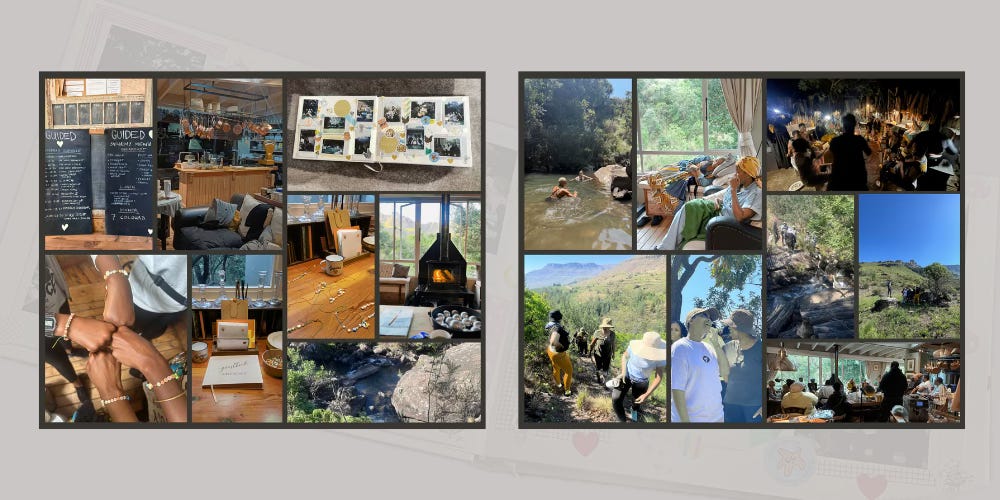
The Guided Retreat
Reimagine the Divine
The Guided Retreat was a chance to reimagine the divine as something present in everyday life, and to remember that leadership is also how we live inside our own lives as people, and as professionals.
Many of us are carrying high demands, moving through overwhelm, and often doing it all while isolated & lonely.
This retreat was structured to for us to integrate the realities of our complex lives as African women with care and clarity.
A New Way of Leadership Development
We grounded our leadership development strategy in being umuntu and having ubuntu. The resonance and uniqueness of the programme is in how it meets the truth of African women’s lives. We know that our true needs and realities haven’t quite been met by existing corporate programmes and wellness experiences, because, ultimately, the programme recognises that our lives are integrated and multidimensional.
Abiding community was at the core. We tapped into true connection that many are sorely lacking in modern life : through honest conversation, heritage activities, shared meals, quiet reflection, and real rest, ghels were able to truly be ghels.
A Love Letter and Interview on Wellness in the workplace

Integrated and Practical Application
We worked with body, biology, and brain function, alongside spiritual and emotional health. The focus was on building actionable, practical toolkits and strategies we can return in every season.
We looked at the internal foundations that shape how we lead, work, and make decisions: who we are, and what we value will be reflected in how we show up in every single relationship and environment we are in.
It was self-driven work held in partnership: with ourselves, the programme and one another. The balance between the restorative weekend, comprehensive programme and gathering as women created a practical and grounded foundation for exploration.
Reimagine the DIVINE
As abantu, we understand that we invite the divine into our lives through dedicated practice; and what are rituals, if not dedicated practice?
However, rituals are often imagined as actions that are so sacred that they are separate from our practical lives.
Rituals are what we do in honour of what we believe. Rituals are an outward signal of our inner state. So, let us then, frame our daily routines, habits and choices as our rituals. They are dedicated practices.
Focus is worship.
Thought is meditation.
Action is manifestation.
How we approach the daily, small parts of our lives, governs the significant and life altering parts. In other words, the DIVINE is in the daily. Interconnectedness is a core principle of life, isintu and ubuntu.
This principle gives us the anchoring to withstand the pressures and pains of life that alienate and debilitate us.
“Routines cultivate discipline and consistency. Consistency brings comfort. Comfort and consistency are vital social anchors.” - Ancestory
The retreat weekend was the culmination of a 16-week self-paced and group programme.
I observed our retreat attendees hold steady in their commitment to themselves to invest in their lives as people and professionals.
I am talking about a group of 15 strangers here. They came with self-respect, and shared kindness. As they embraced personal clarity for their direction and shared belonging, community and joy.
Our retreat is a living example of the abundant cycle of gratitude and generosity.
I’m talking the abundance of nature, to the incredible food our guests brought, made and shared. Oh, and the vibes - respect, kindness, joy, quiet reflection and fun. So much fun.
The cost of the retreat was not a reflection of its value. There is no budget line item or ROI metric that can account for ubuntu.
Generosity becomes her
The Guided Ghels each got a handwritten note with a kwaito affirmation on their bed, which then allocated them to 4 groups: Trompies, Bongo Maffin, TKZee and Boom Shaka.
Each group rotated kitchen duties - cooking, setting the table and tidying up. In the end, we pretty much ended up doing everything together. In addition to our Mashoba Media team, my mom was there, baking scones and running the kitchen from behind the scenes.
As part of the retreat, we planned to have a harvest table with treats for everyone to share.
I invited our guests to bring “a little something” and the Ghels said “oh, isipheko? No problem.”
They showed up with literal groceries, singing. Well, it was a gathering, vele, and they clocked it.
Isipheko is a gesture and practise.
When there is a gathering, we all contribute. Some contribute with goods, others in kind. Either way, we contribute with effort, and participate generously together.
We also had incredibly generous hospitality partners who held the kitchen with us, from a distance. Their love and support infused every meal.
At the end of our time together, we packed and returned with as much food as we had arrived with.
This was after 30 or so people had been fed for an entire weekend and we had umfudumezo for brunch. Our guests packed padkos: snacks, leftovers, produce, dessert, imbiza and our special tea blends, you name it - we shared it.
Give and Gain
“Ukupha ukuziphakela”
An oversimplified translation: Giving to another is to give to yourself.
This proverb simply speaks to generosity as an act of ubuntu to others, and a gift we give to ourselves. I know this to be true, because I too, am umuntu.
A core value of isintu
Isintu embraces life and time as fundamentally cyclical and abundant. So, by extension, the default setting of isintu is generosity.
Isilungu, on the other hand, views time and life as linear, limited because it is a system based on profit creation. This immediately reduces everything into a commodity that can be bought, sold and taken.
The idea that there aren’t enough social and material resources for us all, equally, fuels fear and cruelty. Isilungu’s default setting is greed.
So, in a transactional world:
Generosity is corrupted by opportunism.
Reciprocity is framed as disempowering.
Gratitude is seen as weak and pitiful
This world puts a price on everything, but doesn’t value what matters most.
A Love Letter on Isintu and indigenous intelligence
A Guided gift for you
I love the way isintu looks at generousity as a gift we give to ourselves.
Generousity is give and gain, because : Abundance.
Generosity isn’t give and take, that is linear and limited.
The 3Gs
with love from The Ghels
Grit
Generosity and gratitude are abundant and limitless, but you, as a person, have limitations. You can’t do everything, or be everything to everybody, all the time.
You need healthy boundaries in order to be well and tapped into loving abundance. Healthy boundaries require self-respect and resilience, and they make us more resilient and self-respecting.
Healthy boundaries keep us honest and safe from self-sabotage and manipulation (being manipulated and being manipulative.)
Having boundaries with yourself and others deepens our capacity for generosity.
Grace
We have to be compassionate with ourselves, that is the first step towards embracing generousity as a gift. We can allow ourselves to fully experience our lives, and express ourselves without the pressure to be perfect.
Grace gives us perspective beyond the immediate emotions and circumstances. Grace gives us the wisdom to explore possibilities. Grace gives us perspective and clarity to look at things from different angles. This allows us to grow.
Growth
We cannot experience generousity and stay the same. Generousity grows us in heart and mind. Generosity makes us curious, and that is how we learn. We can only be as generous with others as we are to ourselves, ditto experiencing the generosity of others.
Generosity flows where gratitude is present. It asks us to acknowledge ourselves, and to see the richness of our lives in abundance. Generosity sets us free. Free to try, free to rest, free to stop, say no or start over. Free from judgement, shame and expectations.
There is no expectation to be perfect. We just have to be abantu, and move like we know it: freely, with open hearts and healthy boundaries.
Generosity is give and gain.
What we offer in effort and presence comes back to us as clarity a sense of belonging.
It starts within us, flows to others, and returns to us, so we can deepen our self-respect, and strengthen our community bonds.